I spend way too much time thinking about, playing and listening to trombones and harmonicas. These two instruments grabbed me at different points in my life, and for different reasons.
Many of us had that elementary school experience around fourth grade - after playing "Hot Cross Buns" on ocarinas in third grade, a few students decided that they liked making quasi-musical noise. The band room was available for kids in 4th and 5th grade. I was one of those kids that was eager to goof around in with musical instruments - and kids in band got to leave the main classroom to work with the music teacher for a couple hours a week. That was the main draw for most of us.
On that day early in the fourth grade school year that kids could claim instruments, I had a cold. I stayed home from school for a couple of days. By the time I returned, all of my favorite instruments had been claimed by other kids - the trumpets were gone, the saxophones were gone, the violins were gone. There was a collection of sad orphan instruments - violas, French horns, and trombones. I picked a trombone as the "least worst" instrument available.
Well, I was ambivalent about the trombone for a while. It was an awkward instrument - the slide was hard for short 9-year old arms to manipulate. It was a long horn and I had a tendency to bump into other musicians in the band. I sounded like crap - thin tone and generally off-pitch. I had enough musical awareness to know that I sucked. I didn't quit, though. I had caught the music disease and the trombone was my instrument.
I kept at it and became a half-decent trombonist in high school. I switched to bass trombone for a few years, then back to tenor, then back to bass. I grew to love the instrument and worshipped the great jazz players - J.J. Johnson, Curtis Fuller, Slide Hampton, Frank Rosolino, Carl Fontana and many more. But the trombone was a tough instrument for me. I had to work hard just to avoid deterioration of my modest skills. I kept hitting walls that I couldn't break through. The music in my head wouldn't come out of the horn. I played through college and graduate school, but put it down when I got my first "real job" and embarked on a business career.
I was a band geek, music nerd in high school. I also used to hang around with guys that had garage bands, playing bad covers of "The House of the Rising Sun" and other chestnuts. I wanted to play with those guys, but the trombone was not a natural fit with electric guitar, bass and drums. I can't remember how it happened, but I found a harmonica somewhere. Maybe one of my guitar-playing buddies had one. I discovered it was very easy to get a decent sound of of a harmonica. If you can breathe, you can play it. There is no need for hand-eye coordination or control of obscure embouchure muscles.
I began seeking out recordings of harmonica players. There are many limited players out there - the Bob Dylans, John Lennons, Mick Jaggers, etc. - that see the harmonica as an easy way to add a different sound to their work. Since I was a working-class white kid in a mostly-white high school (some Asian kids, some Mexican kids, no Black kids), I had to find the good players through white people that stole their shit. So John Mayall was my first influence.
I didn't work on the harmonica, but I played it a lot. I could play it while walking down the street. I could play it while I was driving in my car. I kept one in my pocket most of the time - still do. I could play along with guitar players once I figured out how to match harmonica keys to guitar keys (it took me a while to learn that the harmonica sounded best when the key of the harmonica was a 4th higher than the key that the guitar was playing in (so a harmonica in the key of A sounded great when the guitarist is playing in E). This is elementary stuff, but it was revolutionary to me when I was 16 years old.
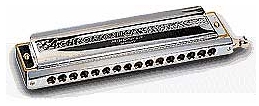
I eventually found the real masters of the harmonica - Little Walter Jacobs, Big Walter Horton, James Cotton, George Harmonica Smith, Junior Wells. Since I was a jazz nut, I found Toots Thielman and fell in love with jazz on the chromatic harmonica. Oh, and Stevie Wonder - a harmonica God for sure. And Howard Levy - the superhero who mastered chromatic music on the little old diatonic harmonica, which is not designed to play chromatic music.
Since I started playing trombone again in March, I have been appreciating the similarities and differences between my chosen musical weapons. Both are very vocal instruments - the trombone can sound like people talking (remember the teacher in the Charlie Brown animated specials?). The harmonica can also put out wails and moans that sound very human. The differences between the two instruments are also obvious - harmonicas can play chords, trombones cannot. Getting a decent sound out of a harmonica is relatively easy (if you can breathe, you can play a chord); getting a decent sound out of the trombone takes quite a lot of practice; it requires unnatural buzzing of lips and control of airflow. The process of learning to play the trombone is like lifting weights - you have to get your reps in and build muscles; if you lay off for any significant period, the trombone "chops" begin to atrophy. Playing a harmonica is like walking - it is easy, almost anyone can do it and you can sit for a long time without losing your ability to walk.
Of course, if you want to truly master one of these instruments, you must be focused and dedicated. In that sense, the instruments are identical.